A bar mat is the one item you order that has to fit something you didn't build — the rail, drip tray or countertop already installed behind your bar. Get the measurement wrong and you don't just waste a carton: a mat that overhangs the rail catches the edge of a glass and tips it, a mat that's too small slides around and looks cheap, and a mat that's too thick won't drop into a shallow drip tray at all.
Most sizing problems we see at the factory start the same way — the buyer measured the outer rim of the tray, copied a competitor's size, or guessed. This is the sizing conversation we have with every bar mat customer, written down.
1. Measure the surface the mat sits on, not the mat you already have
Two surfaces matter, and they're different:
- The bar rail — the flat counter strip in front of the bartender, typically 100–150 mm deep, where drinks are poured and glassware drains.
- The drip tray — the recessed metal or plastic tray under beer taps and soda guns, which is what most "drip" mats actually drop into.
Measure the inside width and depth of that tray, and the flat area of the rail itself, in millimetres. Don't measure an old mat that's already curling — a worn rubber mat can sit 5–8 mm out in every direction, and you'd be copying its mistake.
2. The standard sizes (and where each one goes)
These are the sizes we actually cut in production, in millimetres:
| Size (mm) | Approx. | Where it's used |
|---|---|---|
| 450 × 300 | 17.7 × 11.8 in | Universal bar mat — standard drip trays and service rails |
| 400 × 250 | 15.7 × 9.8 in | Smaller stations, back bar, home bars |
| 300 × 150 | 11.8 × 5.9 in | Narrow rails and espresso machine drip trays |
| Ø 300 round | 11.8 in dia. | Table mats and brand displays |
| Custom die-cut | — | Logo shapes: bottles, coasters, brand outlines |
450 × 300 mm is what we call the universal size — it's the one we ship most, and it fits the majority of standard drip trays. But "most" is the word to watch. I'd rather you measure a rail and find out it's 430 mm than order 450 mm mats and watch them buckle in the middle.
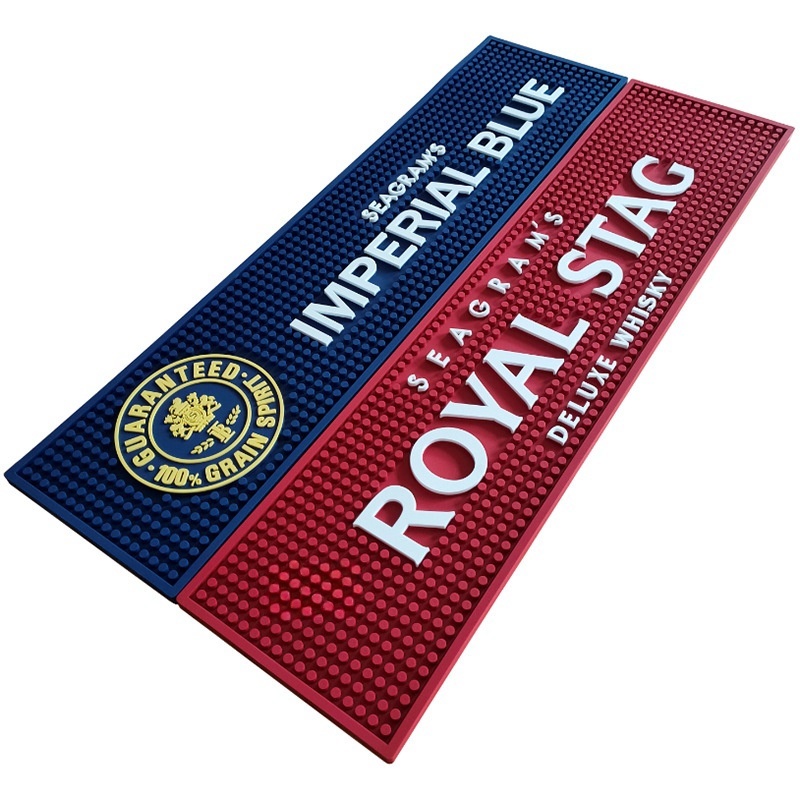
A heavy 6 mm rubber spill mat lies flat on a rail. On a recessed tray, the same mat needs a few millimetres of clearance or it bows in the middle.
3. The overhang rule: leave 5 mm of breathing room
Whatever size you land on, the mat should sit inside its tray — or flush on its rail — rather than overhang it. A mat that overhangs a rail by even 8 mm becomes a lever: a glass set on the lip tips, and a bus tray dragged along the rail catches the corner and peels the mat up.
Rule of thumb: order the mat 5–10 mm smaller than the inside dimension of the tray it drops into, and 3–5 mm narrower than the flat area of a rail it sits on. Rubber has a little give, but it doesn't compress sideways — a mat cut to the exact tray size bows up in the middle and never lies flat. A PVC service mat is more forgiving on flat surfaces, but the same clearance rule still applies.
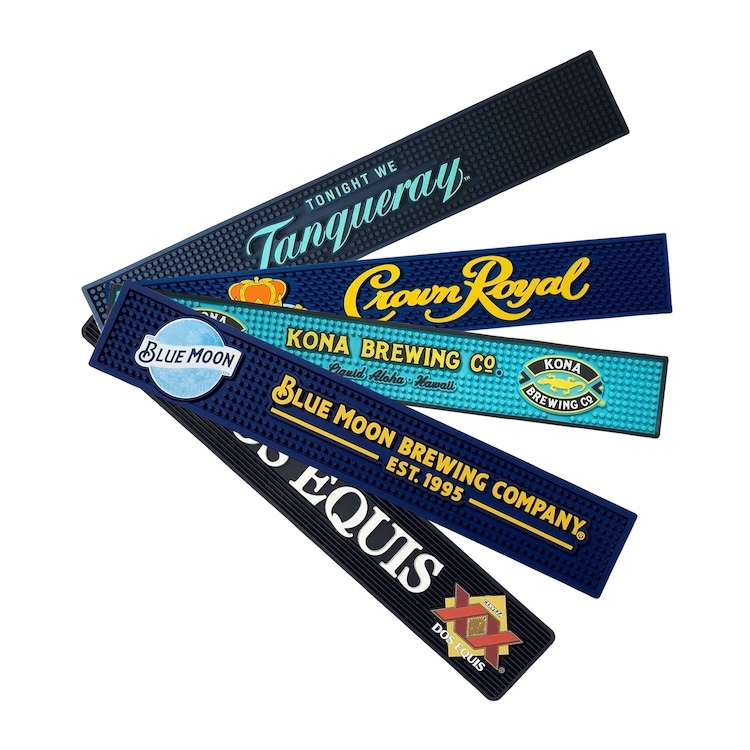
Mat flush with the rail, with a few millimetres of clearance — that's the fit you're aiming for.
4. Thickness changes how a size fits
Size isn't only length and width. A 6 mm rubber mat is the classic heavy bar mat, but a shallow drip tray only 4 mm deep won't take it — the mat sits proud of the tray and slides. A 3 mm mat drops into almost any tray, but it won't hold position on a slightly curved rail the way a heavier 6 mm mat will.
So measure the depth of the tray, not just the footprint. Shallow tray, specify 3 mm. Flat rail rather than a recess, 6 mm is what holds through a busy shift. The full material and thickness comparison is in our custom bar mats buyer's guide.
5. Custom die-cut shapes: the logo outline
If you want a mat cut to the outline of your logo — a bottle, a glass, a round coaster — that's a die-cut mat. Two things decide whether it works:
- Minimum dimension — a die-cut shape needs at least one dimension around 200–300 mm for the shape to read. A logo with fine detail (thin type, small notches) won't cut cleanly; the steel-rule die shears it.
- The die itself — a die is cut once and reused. A simple shape has a modest one-time die cost and reorders reuse it; a complex outline costs more and slows per-piece cutting.
Send us your logo as a vector file (AI, EPS or SVG) and we'll tell you straight whether it will die-cut, or whether a printed logo on a standard rectangle is the better spend. See how we handle custom shapes and logos across our range. A silicone bar mat with logo is the one we steer branded bars toward when they want the logo molded in, not printed on.
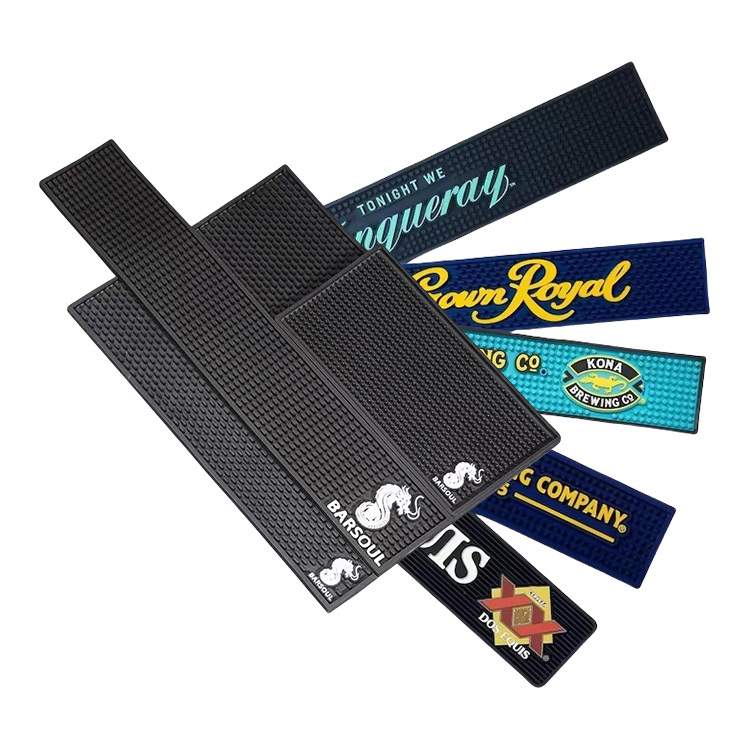
A molded logo on silicone survives scrubbing and years of daily service — but the shape has to be simple enough to cut.
6. Printing-area math: how big your logo actually is
On a 450 × 300 mm mat the printable area is usually the central 300 × 150 mm once you leave a safe margin around the edge — the edge is where mats get scrubbed and where corners curl. A wide horizontal wordmark prints at roughly 250–300 mm and reads clearly from across the bar. A square badge prints at around 100–120 mm and reads from about two metres.
Think in viewing distance: a bar mat is seen from 1–2 metres, so detail smaller than about 5 mm disappears. Simplify the logo before it goes to the mat — drop the tagline and the tiny type. If you want the cheapest route to a branded bar surface, a custom PVC drip mat starts at a 50-piece MOQ, which is where most first orders begin.
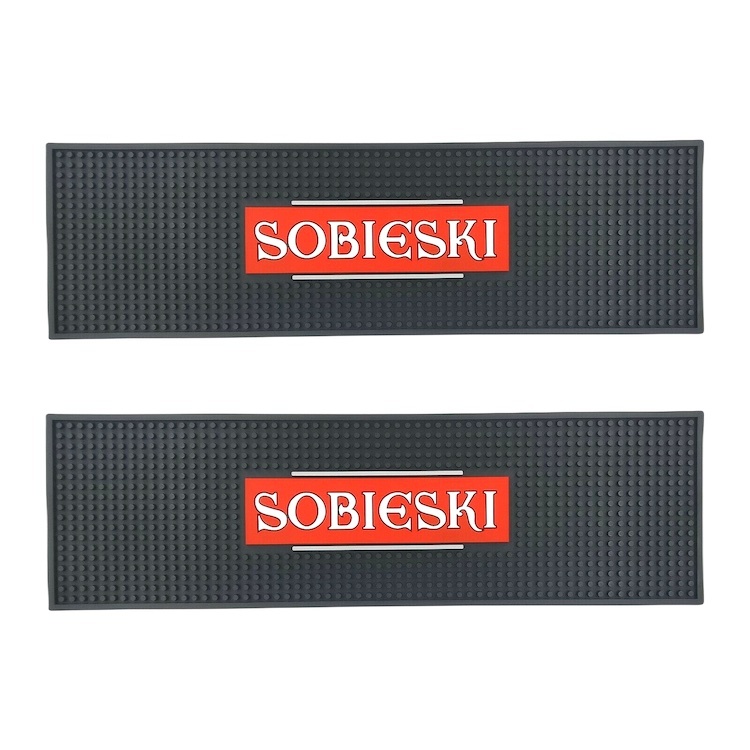
Print, don't die-cut, when the logo is a detailed wordmark — the print area reads from across the bar.
7. The five measurement mistakes we see most
- Measuring the tray's outer rim instead of the inside recess.
- Ordering the exact tray size with no clearance, so the mat bows.
- Forgetting the tray depth and buying 6 mm mats for a 4 mm recess.
- Copying a competitor's size without checking their rail.
- Sending a low-resolution logo for a die-cut and getting a jagged edge.
Ordering the right size in practice
The short version: measure the inside of the tray or the flat of the rail in millimetres, take 5 mm off each side, choose 3 mm or 6 mm from the tray depth, and send a vector logo. That's the whole sizing conversation. Materials, embossing vs printing and per-piece pricing are covered in our custom bar mats buyer's guide, and if you're stocking a whole branded back bar, start with the items you can brand for under $2.
Everything we cut ships from our factory floor, so there's no middleman between your measurement and the die that cuts it.
Shop these bar mats on Alibaba
Four mat types we stock, with their current listing prices. Final price depends on size, material, logo method and quantity — request a quote with your rail measurements.
| Product | Material | Listing price* | MOQ |
|---|---|---|---|
| Silicone Anti-Slip Bar Mat with Logo | Silicone | US$1.45 | 100 pcs |
| Rubber Bar Spill Mat with Logo | Rubber / PVC | US$1.30 | 100 pcs |
| PVC Bar Service Mat with Logo | PVC / Silicone | US$0.60 | 100 pcs |
| Custom PVC Bar Drip Mat | PVC | US$0.60 | 50 pcs |
*Listing prices from our Alibaba store, checked 2026-09-21 — an estimate, not a final quote. Your landed price depends on size, thickness, logo method and order quantity.
See the full range of 390+ products on our Alibaba store, or request a quote with your measurements.